
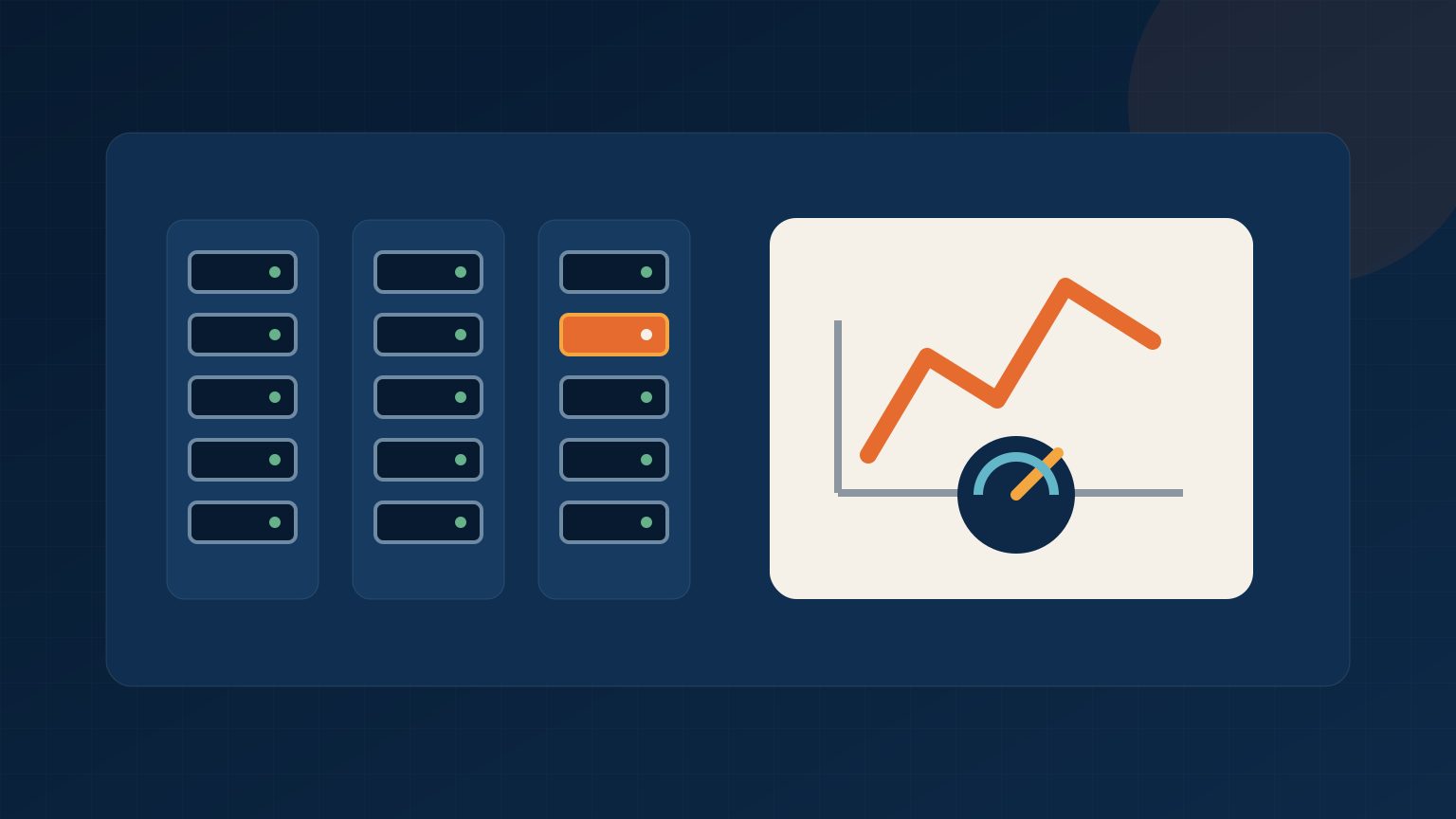
Hourly GPU price is visible and often misleading. The economic unit is a useful completed training, evaluation, fine-tuning, or inference result. Idle allocation, setup, failed runs, data transfer, checkpointing, queue delay, and engineering time can dominate a nominally inexpensive instance.
Characterize the workload
Record model size, precision, memory, sequence or image dimensions, batch behavior, dataset size, storage, network, run duration, checkpoint pattern, and distributed communication. Separate exploratory and repeatable production workloads.
Measure effective utilization
Track GPU duty cycle, memory, input stalls, data loading, CPU bottlenecks, communication, queue time, and preemption. A larger accelerator can finish sooner but still cost more if the workload cannot use it.
Include failure and iteration
Model debugging, environment compatibility, data defects, unstable training, and interrupted runs. Reproducible containers, checkpoints, validation, and small-scale tests reduce expensive failure.
Price inference by service objective
Use request distribution, latency percentile, throughput, context length, batching, availability, and utilization. Compare dedicated, autoscaled, and shared capacity under realistic peaks.
Price the unit of useful work
For training, measure cost per completed experiment or target-quality checkpoint, including failed runs, data loading, checkpoint storage, and engineer wait time. For inference, measure cost per accepted request or output, including batching, idle capacity, retries, and review. Hourly accelerator price is only one factor.
Profile the actual model, precision, sequence length, batch behavior, runtime, and service-level target. Memory capacity can force a more expensive device even when compute is underused. Conversely, a faster device may lower total cost by completing work sooner.
Model reserved, on-demand, spot, and committed capacity against utilization and interruption tolerance. Include regional availability, quota, data transfer, storage, and orchestration overhead.
Govern allocation with workload evidence
Use queues, priorities, quotas, idle reclamation, and cost attribution. Separate interactive development from long-running jobs so one workload cannot make the other unusable. Publish utilization and wait time by team and workload class.
Optimization should start with measurement: input pipeline, kernel utilization, batching, parallelism, checkpoint frequency, and failed work. Purchasing more GPUs can hide an inefficient pipeline while increasing the cost of every future run.
Executive decision record
The decision is which capacity arrangement produces the lowest reliable cost per completed experiment or accepted inference outcome. Write that decision before selecting a model, vendor, framework, or implementation pattern. A written boundary keeps technical exploration connected to the operating outcome and makes it possible to explain why the organization advanced, revised, or stopped the work.
Approval should depend on real workload profiles, utilization and queue data, memory fit, failure and interruption cost, regional supply, and scenario-based demand. The evidence does not need to remove every uncertainty, but it should address the uncertainty capable of changing value, architecture, risk, or ownership. Record the baseline, assumptions, unresolved questions, and the person accepting the next stage.
Failure boundary and operating ownership
The central failure to guard against is selecting by advertised hourly accelerator price while idle time, data stalls, failed runs, and engineer delay dominate. Treat that condition as a testable scenario. Define how the system detects it, what users experience, which action is prevented or reversed, and what evidence reaches the person responsible for recovery.
Long-term accountability sits with the AI platform or infrastructure owner working with workload teams that control model, input, and service-level choices. Supporting specialists can provide platforms, research, review, or delivery capacity, but they cannot substitute for an owner who controls policy and operating change. Name that owner before production and include the ownership path in release evidence and incident procedure.
A practical 90-day application plan
During the first 30 days, convert real workload profiles, utilization and queue data, memory fit, failure and interruption cost, regional supply, and scenario-based demand into a bounded evidence plan. Assign each artifact to a named contributor, identify the representative inputs required, and agree on the comparison baseline before implementation expands. The objective of this period is to expose the assumption most likely to invalidate the work while the cost of changing direction is still low.
During days 31 through 60, build or instrument the smallest complete workflow that can support the decision about which capacity arrangement produces the lowest reliable cost per completed experiment or accepted inference outcome. Include the real data and authorization path where feasible, record exceptions, and review difficult cases with the people who own the underlying process. Resist adding breadth until the team can explain the measured behavior of this narrow slice.
During days 61 through 90, test the boundary represented by selecting by advertised hourly accelerator price while idle time, data stalls, failed runs, and engineer delay dominate. Exercise degraded dependencies, ambiguous inputs, recovery, and handoff rather than demonstrating only successful cases. End the period with a written advance, revise, or stop decision that cites evidence, residual exposure, expected operating cost, and the next authority boundary.
The review should be accepted by the AI platform or infrastructure owner working with workload teams that control model, input, and service-level choices. That group should confirm not only that the system can work, but that ownership, support capacity, monitoring, and change control are credible. If those conditions are absent, the responsible outcome is another bounded learning stage rather than an unsupported production commitment.
Practical checklist
- Workload and memory profile
- Data and storage path
- Effective GPU utilization
- Queue and provisioning delay
- Failure and rerun rate
- Engineering setup and support
- Completed-result and service-level cost
Engagement scenario
A team compares two GPU options for evaluation. The cheaper hourly instance takes longer and suffers input stalls. After profiling data loading and completion time, a better-matched instance plus cached datasets lowers cost per completed evaluation.
Continue reading
- [Kubernetes GPU workloads](/kubernetes-gpu-workloads-production)
- [AI inference cost optimization](/ai-inference-cost-optimization)
Sources and further reading
- [NVIDIA TensorRT performance optimization](https://docs.nvidia.com/deeplearning/tensorrt/latest/performance/optimization.html)