
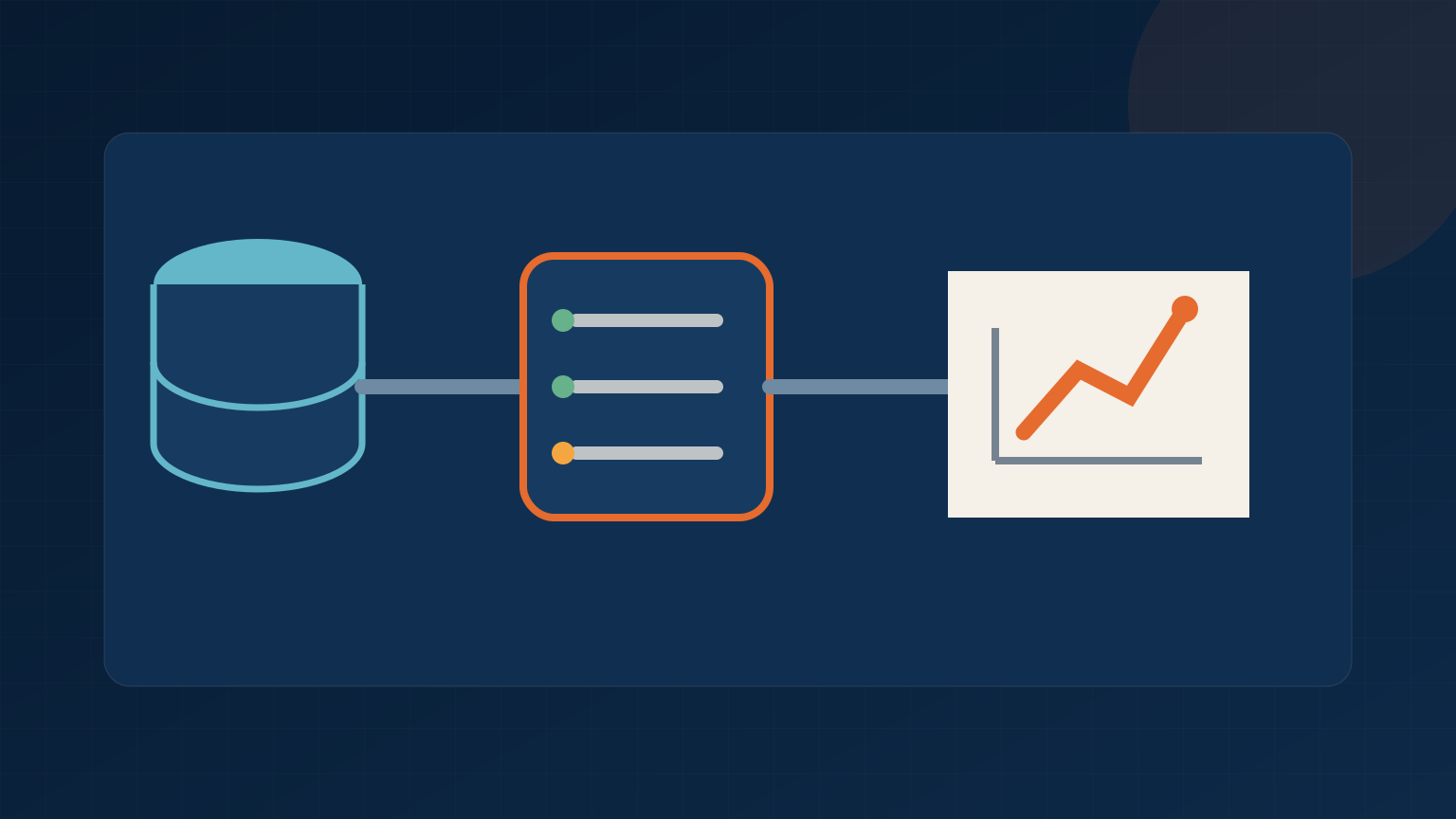
AI systems inherit the uncertainty of their data. A model can be evaluated carefully and still fail after launch because a parser changed, an upstream field drifted, permissions were lost in an index, or the training population no longer resembles production.
The response is not to centralize every byte before beginning. It is to turn the data needed by a bounded workflow into an owned, tested, observable product.
Define the consumer contract
Identify which model, evaluation, retrieval, product, or operator consumes the data. Specify schema, semantics, freshness, volume, quality, access, retention, and expected failure behavior.
Contracts should describe meaning, not only column types. A status field without lifecycle semantics can pass schema validation and still corrupt a decision.
Preserve lineage and reproducibility
Record source versions, transformations, filters, labeling rules, and code or configuration used to produce datasets. Training and evaluation artifacts should be reproducible or at least reconstructable from durable snapshots.
Test quality at the decision boundary
Use completeness, validity, duplication, freshness, distribution, label agreement, and source coverage checks tied to the workflow. Define which violations stop a run, degrade a feature, or alert an owner.
Operate access and deletion end to end
Propagate permissions, retention, consent, and deletion into derived datasets, indexes, features, logs, and evaluation stores. AI convenience should not create an ungoverned copy of sensitive information.
Define data contracts around model behavior
For every source, record authority, owner, schema, freshness, completeness, permissions, retention, and allowed use. Add semantic expectations that schemas cannot express: which timestamp controls, how status changes, what a missing field means, and whether historical corrections propagate. Models magnify ambiguity because they can produce plausible output from inconsistent inputs.
Version transformations, feature or document preparation, and evaluation populations. Preserve lineage from an output back to source versions and processing code. This is necessary for debugging, access review, deletion, and reproducing a historical decision after the data has changed.
Measure data quality in terms of affected workflows. A one-percent null rate may be harmless in an optional description and critical in an authorization field. Route violations to an owner and define whether the system stops, degrades, or continues with a visible warning.
Operate data change as a release
New sources, parsing rules, labels, and retention policies can change AI behavior without a model deployment. Run representative evaluations and reconciliation before promotion. Use staged backfills and compare counts, distributions, and downstream outcomes.
Monitor freshness, volume, schema, permission, and semantic drift. Connect alerts to user impact and a recovery action. A healthy pipeline is not merely one that runs; it delivers data inside the quality boundary the product assumes.
Executive decision record
The decision is whether the system receives authoritative, permitted, timely, and interpretable inputs inside the quality boundary its behavior assumes. Write that decision before selecting a model, vendor, framework, or implementation pattern. A written boundary keeps technical exploration connected to the operating outcome and makes it possible to explain why the organization advanced, revised, or stopped the work.
Approval should depend on source contracts, semantic tests, lineage, versioned transformations, permission and deletion checks, reconciliation, and workflow-level quality measures. The evidence does not need to remove every uncertainty, but it should address the uncertainty capable of changing value, architecture, risk, or ownership. Record the baseline, assumptions, unresolved questions, and the person accepting the next stage.
Failure boundary and operating ownership
The central failure to guard against is operating pipelines that run successfully while ambiguous or stale data quietly changes model outputs and business decisions. Treat that condition as a testable scenario. Define how the system detects it, what users experience, which action is prevented or reversed, and what evidence reaches the person responsible for recovery.
Long-term accountability sits with domain data owners and the product data team jointly, with model engineers responsible for downstream assumptions. Supporting specialists can provide platforms, research, review, or delivery capacity, but they cannot substitute for an owner who controls policy and operating change. Name that owner before production and include the ownership path in release evidence and incident procedure.
A practical 90-day application plan
During the first 30 days, convert source contracts, semantic tests, lineage, versioned transformations, permission and deletion checks, reconciliation, and workflow-level quality measures into a bounded evidence plan. Assign each artifact to a named contributor, identify the representative inputs required, and agree on the comparison baseline before implementation expands. The objective of this period is to expose the assumption most likely to invalidate the work while the cost of changing direction is still low.
During days 31 through 60, build or instrument the smallest complete workflow that can support the decision about whether the system receives authoritative, permitted, timely, and interpretable inputs inside the quality boundary its behavior assumes. Include the real data and authorization path where feasible, record exceptions, and review difficult cases with the people who own the underlying process. Resist adding breadth until the team can explain the measured behavior of this narrow slice.
During days 61 through 90, test the boundary represented by operating pipelines that run successfully while ambiguous or stale data quietly changes model outputs and business decisions. Exercise degraded dependencies, ambiguous inputs, recovery, and handoff rather than demonstrating only successful cases. End the period with a written advance, revise, or stop decision that cites evidence, residual exposure, expected operating cost, and the next authority boundary.
The review should be accepted by domain data owners and the product data team jointly, with model engineers responsible for downstream assumptions. That group should confirm not only that the system can work, but that ownership, support capacity, monitoring, and change control are credible. If those conditions are absent, the responsible outcome is another bounded learning stage rather than an unsupported production commitment.
Practical checklist
- Named data-product owner and consumers
- Semantic contract and freshness expectation
- Source and transformation lineage
- Quality tests with response policy
- Versioned training and evaluation data
- Access, retention, and deletion propagation
- Pipeline observability, replay, and runbooks
Engagement scenario
A document assistant receives data from three repositories. The platform records source identity and permissions, rejects malformed parses, measures ingestion lag, and deletes derived chunks when the source is removed. Retrieval evaluations run against versioned snapshots before parser changes are released.
Continue reading
- [AI-ready data platform](/ai-ready-data-platform-architecture)
- [Production RAG architecture](/production-rag-architecture)
- [AI platform observability](/ai-platform-observability-opentelemetry)
Sources and further reading
- [NIST AI Risk Management Framework](https://www.nist.gov/itl/ai-risk-management-framework)