
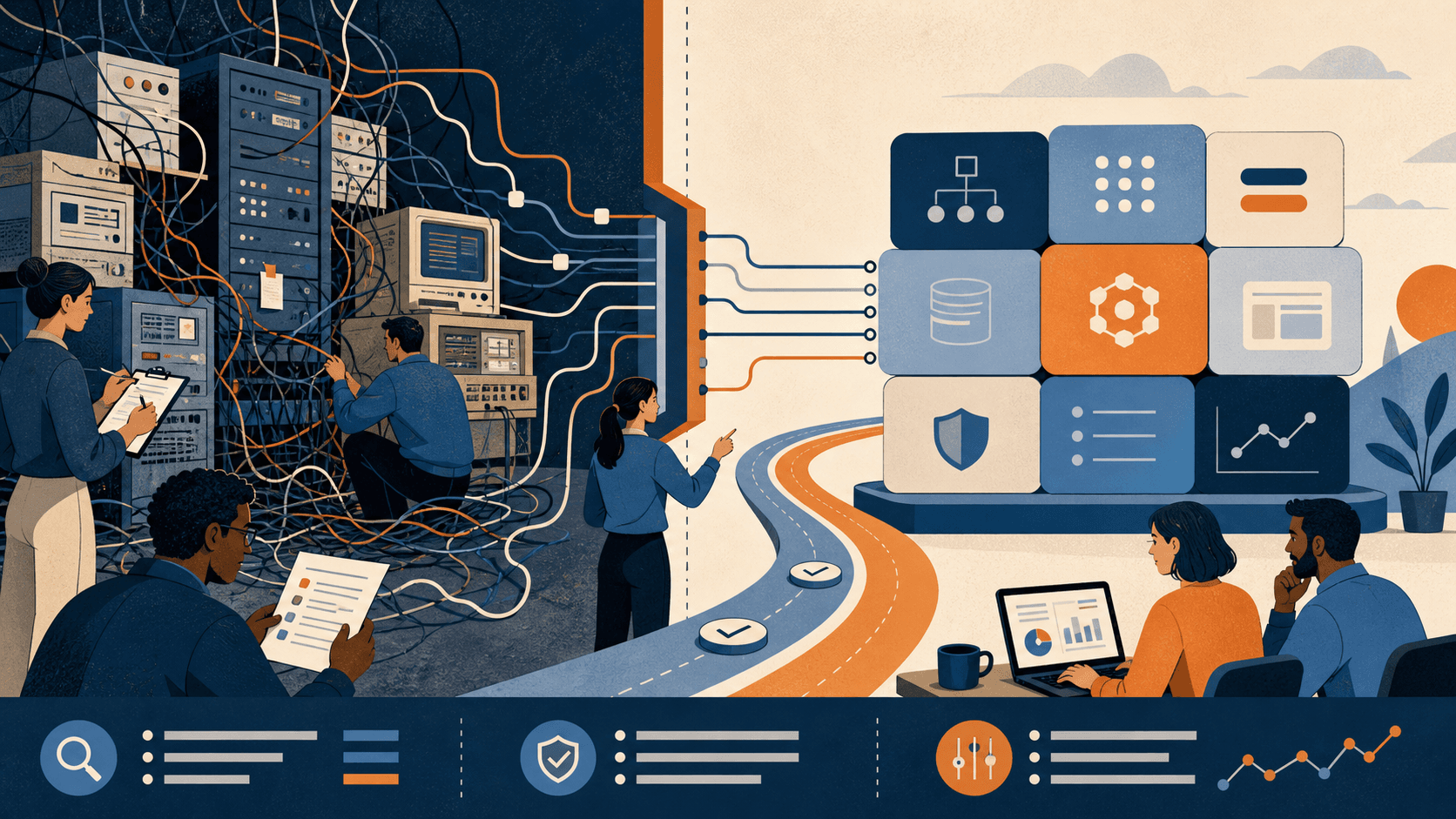
Adding an AI interface to an unstable legacy system can make old ambiguity faster and harder to audit. The objective is not to rewrite everything. It is to create reliable seams around the workflow the AI system must read or change.
Map system-of-record truth
Identify where authoritative state lives, how it changes, which fields are derived, and what permissions apply. Reconcile undocumented rules before exposing tools to an agent.
Create bounded service interfaces
Wrap critical capabilities with typed APIs, validation, idempotency, authorization, and audit. Avoid granting an AI system direct broad database access.
Build observability and test fixtures
Trace critical journeys, capture representative fixtures, and create contract and regression tests. Modernization should improve the team’s ability to understand behavior before adding model variance.
Modernize by workflow slice
Choose one valuable path and create the data, API, identity, and deployment foundation it requires. Reuse those capabilities for subsequent slices instead of launching a multi-year rewrite disconnected from outcomes.
Stabilize knowledge before changing architecture
Map business capabilities, data authority, interfaces, operational dependencies, failure history, and undocumented manual work. Add observability and characterization tests around critical behavior before replacement. This creates a reliable comparison and reduces the chance that modernization removes an exception the business still depends on.
Identify seams where a capability can be isolated behind a stable interface. Use incremental patterns such as facades, event publication, data replication with clear authority, and strangler migration. A wholesale rewrite combines product change, platform change, and data migration into one difficult release.
Do not let an AI feature become an excuse to bypass core problems. Models need trustworthy identity, data, workflow, and audit boundaries. If those are weak, the first investment may be conventional software and data engineering.
Measure modernization by change safety
Track deployment frequency, lead time, recovery, defect escape, unsupported dependencies, and time required to change a business rule. Infrastructure age is not the only issue; a stable older component may be less risky than a new service no one can operate.
Retire systems explicitly. Define data reconciliation, archival, user migration, parallel-run evidence, rollback, and shutdown authority. Running old and new indefinitely can double complexity and obscure the source of truth.
Executive decision record
The decision is which legacy capability must be stabilized, isolated, replaced, or retained before an AI-enabled workflow can rely on it. Write that decision before selecting a model, vendor, framework, or implementation pattern. A written boundary keeps technical exploration connected to the operating outcome and makes it possible to explain why the organization advanced, revised, or stopped the work.
Approval should depend on capability and dependency map, characterization tests, observability, migration seams, reconciliation, staged cutover, and retirement evidence. The evidence does not need to remove every uncertainty, but it should address the uncertainty capable of changing value, architecture, risk, or ownership. Record the baseline, assumptions, unresolved questions, and the person accepting the next stage.
Failure boundary and operating ownership
The central failure to guard against is combining a wholesale rewrite, data migration, and probabilistic product feature into one release with no trustworthy behavioral baseline. Treat that condition as a testable scenario. Define how the system detects it, what users experience, which action is prevented or reversed, and what evidence reaches the person responsible for recovery.
Long-term accountability sits with the business capability owner and platform team that will continue operating both transition and target systems. Supporting specialists can provide platforms, research, review, or delivery capacity, but they cannot substitute for an owner who controls policy and operating change. Name that owner before production and include the ownership path in release evidence and incident procedure.
A practical 90-day application plan
During the first 30 days, convert capability and dependency map, characterization tests, observability, migration seams, reconciliation, staged cutover, and retirement evidence into a bounded evidence plan. Assign each artifact to a named contributor, identify the representative inputs required, and agree on the comparison baseline before implementation expands. The objective of this period is to expose the assumption most likely to invalidate the work while the cost of changing direction is still low.
During days 31 through 60, build or instrument the smallest complete workflow that can support the decision about which legacy capability must be stabilized, isolated, replaced, or retained before an AI-enabled workflow can rely on it. Include the real data and authorization path where feasible, record exceptions, and review difficult cases with the people who own the underlying process. Resist adding breadth until the team can explain the measured behavior of this narrow slice.
During days 61 through 90, test the boundary represented by combining a wholesale rewrite, data migration, and probabilistic product feature into one release with no trustworthy behavioral baseline. Exercise degraded dependencies, ambiguous inputs, recovery, and handoff rather than demonstrating only successful cases. End the period with a written advance, revise, or stop decision that cites evidence, residual exposure, expected operating cost, and the next authority boundary.
The review should be accepted by the business capability owner and platform team that will continue operating both transition and target systems. That group should confirm not only that the system can work, but that ownership, support capacity, monitoring, and change control are credible. If those conditions are absent, the responsible outcome is another bounded learning stage rather than an unsupported production commitment.
Practical checklist
- System-of-record and business-rule map
- Identity and permission boundary
- Typed, audited service interfaces
- Representative test fixtures
- Critical-journey telemetry
- Incremental migration and rollback
- AI tool scopes and approval policy
Engagement scenario
A field-service company wants an agent to reschedule work. The first modernization slice creates a validated scheduling API and event log around the legacy database. The agent can propose changes but cannot bypass capacity and approval rules.
Continue reading
- [Enterprise agent architecture](/enterprise-ai-agent-architecture)
- [Software discovery phase](/software-discovery-phase-guide)
Sources and further reading
- [CISA Secure by Design](https://www.cisa.gov/resources-tools/resources/secure-by-design)