
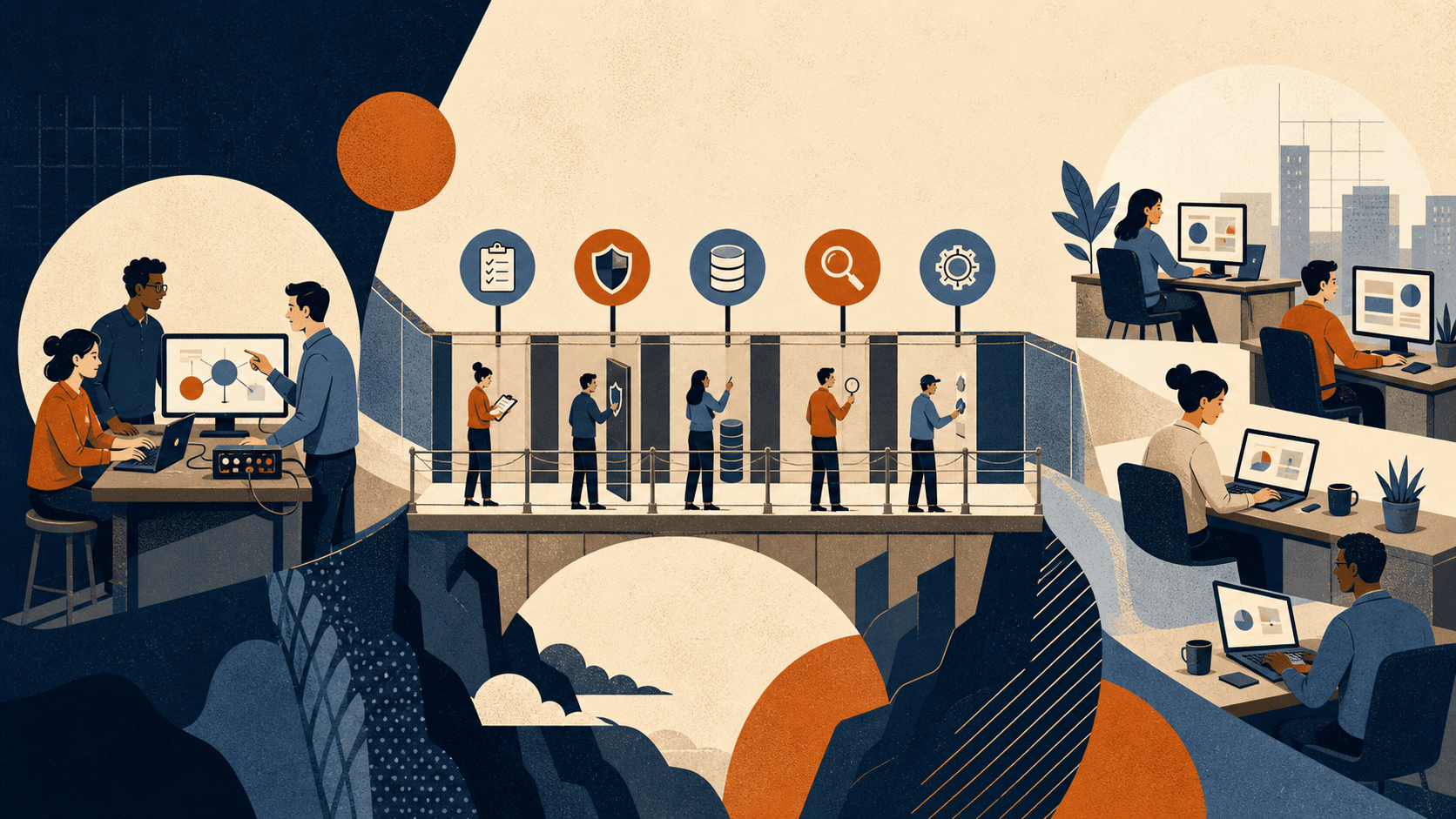
Pilots often optimize for demonstration speed: curated data, manual setup, a small user group, and limited failure handling. Production optimizes for repeatable behavior under real identity, data, load, security, and support conditions.
The gap closes when teams convert the pilot into explicit acceptance evidence and an owned operating system.
Audit the pilot assumptions
List manual steps, curated inputs, hidden credentials, unsupported edge cases, temporary infrastructure, and claims that lack representative evaluation. Decide which assumptions must be removed before release.
Build production acceptance evidence
Create task populations, critical slices, severe-failure limits, latency and cost budgets, security tests, accessibility checks, and an operator workflow. Freeze regressions and version all behavior-changing dependencies.
Integrate and instrument the complete path
Add identity, permissions, source systems, telemetry, rate limits, fallbacks, incident handling, and data lifecycle controls. Test downstream effects and partial failures, not only the model response.
Roll out by risk cohort
Start with low-consequence tasks or a limited user group. Monitor corrections, escalations, support load, cost, and adoption. Expand authority only when evidence supports it and rollback remains possible.
Diagnose why the pilot cannot scale
List every condition the pilot assumes: curated inputs, manual cleanup, broad credentials, one expert user, fixed prompt, low volume, forgiving latency, and informal support. Production work is the process of replacing those assumptions with owned systems and explicit service boundaries.
Classify the gap across product, data, model behavior, integration, security, reliability, operations, and organizational adoption. Assign an owner and evidence requirement to each. A single “productionize” workstream hides dependencies and makes schedule risk impossible to manage.
Revalidate value with the production workflow. Controls and human review may change speed and economics. Use accepted outcomes under realistic conditions rather than demo satisfaction to decide whether the full build still deserves funding.
Roll out through controlled exposure
Begin with shadow operation or recommendation-only mode where appropriate. Move to bounded users, data, actions, and hours before widening authority. Define automatic rollback or disable conditions and keep a non-AI path available for critical work.
Measure adoption, completion, escalation, correction, latency, cost, and incidents by cohort. A rollout is not complete when access is enabled; it is complete when the owning organization can operate the system, explain its limits, and improve it safely.
Executive decision record
The decision is whether the pilot still creates sufficient value after production controls, real integration, review, support, and service constraints are included. Write that decision before selecting a model, vendor, framework, or implementation pattern. A written boundary keeps technical exploration connected to the operating outcome and makes it possible to explain why the organization advanced, revised, or stopped the work.
Approval should depend on documented pilot assumptions, gap ownership, realistic end-to-end evaluation, rollout cohorts, rollback conditions, runbooks, and outcome measures. The evidence does not need to remove every uncertainty, but it should address the uncertainty capable of changing value, architecture, risk, or ownership. Record the baseline, assumptions, unresolved questions, and the person accepting the next stage.
Failure boundary and operating ownership
The central failure to guard against is treating a successful curated demonstration as a nearly complete product and discovering essential controls only during broad rollout. Treat that condition as a testable scenario. Define how the system detects it, what users experience, which action is prevented or reversed, and what evidence reaches the person responsible for recovery.
Long-term accountability sits with the product organization that will operate and fund the workflow, not the temporary pilot or innovation team. Supporting specialists can provide platforms, research, review, or delivery capacity, but they cannot substitute for an owner who controls policy and operating change. Name that owner before production and include the ownership path in release evidence and incident procedure.
A practical 90-day application plan
During the first 30 days, convert documented pilot assumptions, gap ownership, realistic end-to-end evaluation, rollout cohorts, rollback conditions, runbooks, and outcome measures into a bounded evidence plan. Assign each artifact to a named contributor, identify the representative inputs required, and agree on the comparison baseline before implementation expands. The objective of this period is to expose the assumption most likely to invalidate the work while the cost of changing direction is still low.
During days 31 through 60, build or instrument the smallest complete workflow that can support the decision about whether the pilot still creates sufficient value after production controls, real integration, review, support, and service constraints are included. Include the real data and authorization path where feasible, record exceptions, and review difficult cases with the people who own the underlying process. Resist adding breadth until the team can explain the measured behavior of this narrow slice.
During days 61 through 90, test the boundary represented by treating a successful curated demonstration as a nearly complete product and discovering essential controls only during broad rollout. Exercise degraded dependencies, ambiguous inputs, recovery, and handoff rather than demonstrating only successful cases. End the period with a written advance, revise, or stop decision that cites evidence, residual exposure, expected operating cost, and the next authority boundary.
The review should be accepted by the product organization that will operate and fund the workflow, not the temporary pilot or innovation team. That group should confirm not only that the system can work, but that ownership, support capacity, monitoring, and change control are credible. If those conditions are absent, the responsible outcome is another bounded learning stage rather than an unsupported production commitment.
Practical checklist
- Pilot assumption and gap register
- Representative acceptance evaluation
- Security and data review
- Identity and production integrations
- Observability and incident response
- Controlled rollout cohorts
- Runbooks, support, rollback, and owner
Engagement scenario
A sales-document pilot becomes a controlled production release only after permissions are enforced at retrieval, citation regressions are automated, customer data is redacted from telemetry, and a review queue handles low-evidence responses.
Continue reading
- [LLM evaluation framework](/llm-evaluation-framework-production)
- [AI platform observability](/ai-platform-observability-opentelemetry)
Sources and further reading
- [NIST AI RMF Core](https://airc.nist.gov/airmf-resources/airmf/5-sec-core/)